
Lithium battery shredding in the automotive industry: innovation and recycling
Lithium and the future of the electric automotive industry
Lithium represents a crucial resource in the evolution of the automotive industry, particularly for the production of electric vehicles (EVs) and hybrid electric vehicles (HEVs), thanks to its exceptional chemical and physical properties. The ability of lithium batteries to store high energy density allows EVs to travel longer distances on a single charge, offering an effective solution to concerns regarding electric vehicle range. Furthermore, their extended lifespan reduces the need for frequent replacements, contributing to greater sustainability and reducing long-term costs for consumers and businesses.
The reduced charging times of lithium batteries further improve the practicality of EVs, making them an increasingly competitive alternative to internal combustion engine vehicles. These batteries find application not only in EVs but also in hybrid vehicles, where they combine efficiency and emission reduction, and in energy storage systems, where they play a fundamental role in integrating renewable energies such as solar and wind into the energy mix.
Challenges and solutions in lithium battery recycling
Despite the advantages, the industry faces significant challenges, including the cost of lithium batteries, which remains high compared to other technologies. Furthermore, the increase in demand is raising issues related to the sustainable sourcing of lithium, given the environmental impact associated with its extraction and refining. Safety also represents a concern, as lithium batteries can present risks if damaged or handled inappropriately.
To address these challenges, the industry is actively dedicated to the research and development of new chemistries for lithium batteries, aiming to improve energy density, lifespan, and safety. A particularly promising area is battery recycling, which can not only reduce environmental impact but also provide a sustainable method for recovering valuable materials, helping to mitigate issues related to lithium supply.
Innovation and safety in lithium battery shredding
The recycling of this type of battery is precisely the direction taken by an important national client who turned to SatrindTech for the implementation of the shredding section of a pilot plant for the treatment and recovery of these products.
It is important to keep in mind that lithium is a highly reactive chemical element. Shredding it can be dangerous for several reasons: reaction with water and air, fire risk, and, not least, explosion. Therefore, shredding lithium batteries in water is an operation that can be dangerous and harmful to the environment.
The solution to the hazards in lithium battery shredding lies in inertization, for which several methods exist. The choice of the most suitable inertization method depends on several factors, including:
- the type of lithium battery;
- the size and shape of the battery;
- available resources;
- safety requirements.
Given the inertization process carried out in the plant, this allows for shredding to proceed, which in the specific case of this supply takes place completely in a water bath.
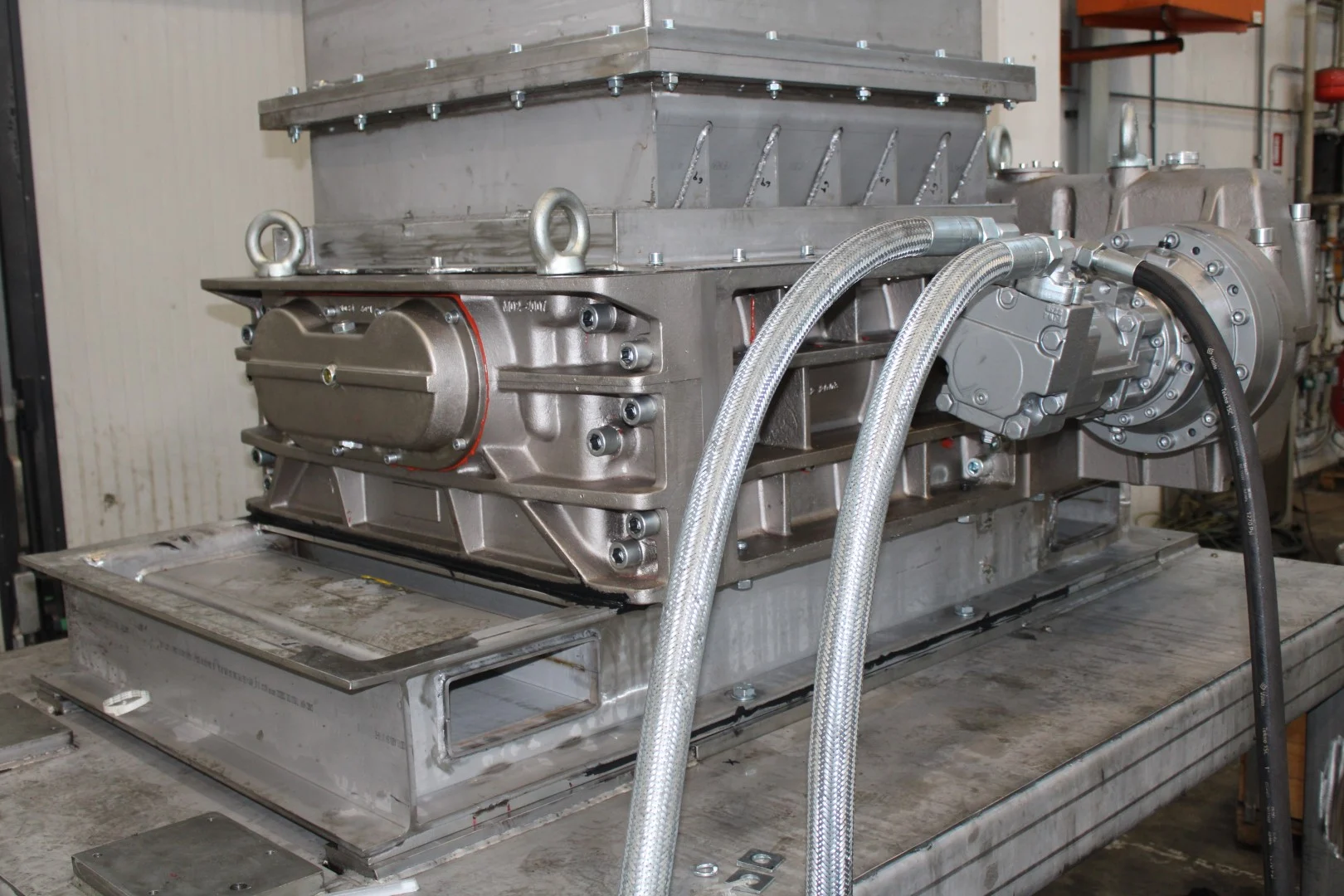
For the lithium battery shredding process, a 37 kW dual-shaft shredder from the K50 series was chosen, with a 1 m grinding chamber and a mix of 30 mm blades with different hooks, equipped with a special frame and hopper.
The grinding chamber is entirely nickel-plated and all the structural metalwork is made of stainless steel.
Special seals placed between the structural components and between the blades, whose seats were obtained through specific mechanical processing, contribute to the water tightness. A recirculation system feeds the water back into the hopper.
The line sensors, the grinding process, and the other equipment upstream and downstream of the shredder are managed by PLCs that communicate with each other via a Profinet network.
Lithium battery recycling stands as one of the most promising solutions for addressing the environmental, economic, and safety challenges linked to the expansion of the electric automotive industry. The collaboration with SatrindTech for the realization of a pilot plant for the treatment and recovery of lithium batteries marks a significant step toward innovation and sustainability in this sector. This initiative demonstrates a concrete commitment to seeking safe and efficient solutions for the treatment of used batteries, with a focus on mitigating environmental risks and ensuring safety.
In conclusion, the implementation of a system that guarantees safety in the lithium battery shredding process and the recovery of valuable materials from used batteries is essential to promote recycling as a sustainable alternative to the extraction of new raw materials.