
From hospital waste to waste-to-energy
Categories of hospital waste
Hospital waste, also known as healthcare waste or medical waste, includes a wide range of materials that have been used in healthcare facilities such as hospitals, clinics, laboratories, and other medical settings. This waste is classified into different categories based on its potential hazard and disposal process. The main categories of hospital waste include:
- Infectious waste: this waste includes infected or potentially infected materials, such as human tissues, used syringes, needles, bandages, sharp objects, biological samples, and other waste contaminated by blood, secretions, or pathogens.
- Hazardous waste: this category includes hazardous chemicals, expired or unused pharmaceuticals, chemicals used in laboratories, radiology, and other medical procedures that may contain hazardous materials.
- General waste: this waste includes non-infectious and non-hazardous materials used in hospitals, such as paper, plastic, cardboard, packaging, uncontaminated food, and other general waste.
- Radioactive waste: this waste includes materials contaminated by ionizing radiation, such as gloves or clothing used in radiology, expired radiopharmaceuticals, and other radioactive substances.
- Pharmaceutical waste: this category includes expired or unused pharmaceuticals, medicine containers, unclaimed prescriptions, and other drug-related waste.
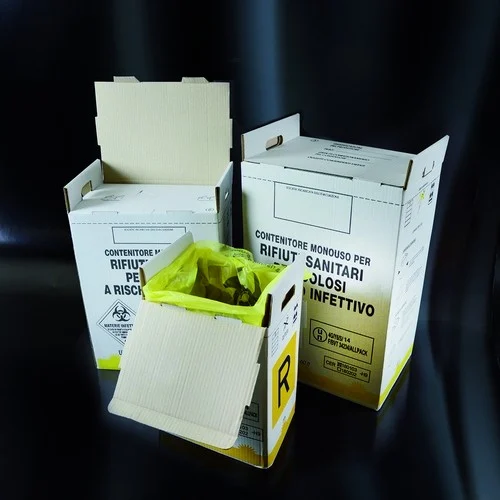
It is essential to properly manage hospital waste to prevent the spread of infections, protect the environment, and ensure the safety of healthcare personnel and the public. With this in mind, a Milan-based engineering company specializing in the construction of environmental sector facilities commissioned two twin systems from us for shredding hospital waste in 60-liter cardboard boxes, with the aim of obtaining, after a complex high-temperature treatment, solid secondary fuel (abbr. SSF).
SSF can be used in existing industrial facilities (cement plants, steel mills, thermoelectric power plants, etc.) as a substitute for traditional fuels and in waste-to-energy plants for electricity production: from hospital waste to waste-to-energy.
Design and construction of two systems for hospital waste treatment
We designed and built two shredding systems, each equipped with a 60 HP 4-shaft shredder, model 4S 12/60, with 30mm screening grids, to ensure that the material is discharged at a controlled particle size, guaranteeing uniformity of the final volume of processed material.
Hospital waste is contained in 60-liter cardboard boxes and deposited in typical waste bins, hooked to a bin loader that lifts, tilts, and empties the boxes into the shredder’s loading hopper.
The hopper is equipped with a large gate synchronized with the bin loader, steam injection, and extraction. A discharge screw beneath the shredder conveys the material to the next treatment cycle. The entire cycle is automatic, managed by a Siemens PLC, in line with the most advanced requirements of the Internet of Things and therefore Industry 4.0.
To prevent cardboard boxes from jamming in the loading hopper, two “agitators” driven by gearmotors rotate alternately in one direction and the other, moving the boxes and preventing bridging.
The waste-to-energy concept
The concept of “waste-to-energy” (WTE) refers to a process in which municipal solid waste or other types of waste are used as raw material to produce energy, usually in the form of electricity or heat. This process involves controlled combustion or gasification of waste to generate heat, which is then converted into electrical or thermal energy through turbines or other devices. The primary objective of waste-to-energy is to reduce the amount of waste destined for landfills, recover energy from renewable resources, and contribute to sustainable waste management and energy supply.
Our sales team is at your complete disposal to provide further information and present our extensive range of industrial shredders.