
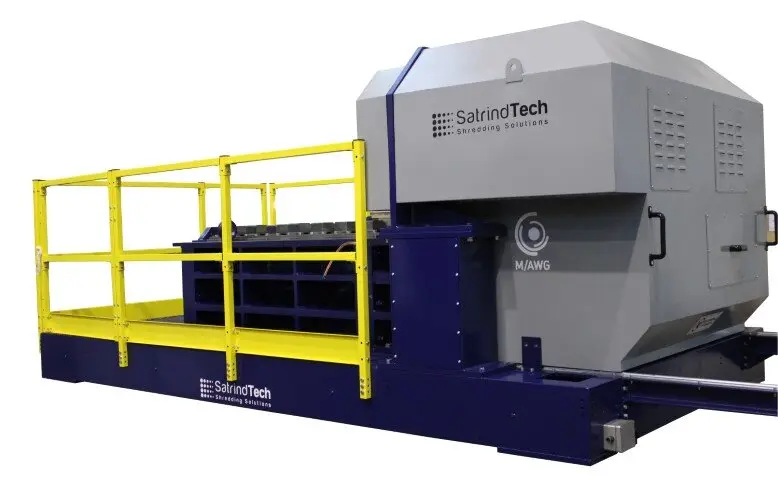
Industry 4.0 Shredders: technical breakdown of requirements.
In themselves, most industrial shredder supplies normally include a grinding body controlled by an electrical panel, with a support frame and a loading hopper. A loading and/or unloading conveyor belt and other accessories can be added to this.
To meet legislative requirements, which we will examine in greater detail later, our equipment has had to incorporate some of the legal requirements first and foremost: particularly regarding CNC control with a simple human-machine interface, while taking compliance with the most recent safety standards for granted.
Secondly, it became necessary to equip the machinery with a remote assistance system.
However, all of this is still not sufficient for the supply to fully comply with the legislative requirements.
This is because the interconnection to factory IT systems, automated integration with the factory logistics system, and continuous monitoring of working conditions can only be designed and prepared by the customer, who is the only one who knows and can intervene in their own production process.
Ultimately, SatrindTech is able to offer Industry 4.0 shredders that are prepared for technical requirements (compliance) and that integrate into the customer’s Industry 4.0 project; the customer will then be responsible for certification in order to obtain the intended bonus.
The legislative framework
In 2017, under the then Minister of Economic Development Carlo Calenda, head of the MISE, the National Industry 4.0 Plan (Industry 4.0 Plan) was launched with the intent of “bringing industrial policy back to the center of government action and encouraging investment in innovation and competitiveness through a series of organic and complementary measures, so that businesses could seize the opportunities linked to the fourth industrial revolution.”
This was fulfilled in the 2017 budget law, in the initiative known to everyone as Industry 4.0, through which certain purchases of machinery within specific deadlines that met very precise requirements could be depreciated—or rather, super- and hyper-depreciated—through a very specific procedure.
The legislative initiative did not end with 2017 but has been renewed from time to time in subsequent budget laws, albeit with slight modifications, always with a view to encouraging investment within the Industry 4.0 paradigm:
- 2017: Law of December 11, 2016 n. 232 (Official Gazette 21.12.2016 n. 297 S.O.) – Art. 1, paragraphs 8-13 / Annex A Functional assets for the Industry 4.0 model
- 2018: Law of December 27, 2017 n. 205 (Official Gazette 29.12.2017 n. 302 S.O.) – Art. 1, paragraphs 29-36 and 46-56
- 2019: Law of December 30, 2018 n. 145 (Official Gazette 31.12.2018 n. 302, S.O.) – Art. 60-65
- 2020: Law of December 27, 2019, n. 160 (Official Gazette 30.12.2019, n. 304, S.O.) – Art. 184-189
The list of machinery functional to Industry 4.0, and therefore eligible for financial benefits, is contained in Annex A of Law 232 of December 2016. The annex also lists the technical requirements that such supplies must mandatory possess to access the bonus. Subsequent budget laws, in re-proposing and confirming the funding, have always referred to this annex.
Four years after the start, we asked ourselves if the opportunity was seized and if it brought us real measurable benefits, at least to the Industry 4.0 shredder market.
Technical legislative requirements
Annex A of Law 232 dictates the technical characteristics that must be possessed by “machine tools for de-production and repackaging to recover materials and functions from industrial waste and end-of-life return products” (this is the class of machinery into which Industry 4.0 shredders fall) to meet the required standards:
- control via CNC (Computer Numerical Control) and/or PLC (Programmable Logic Controller);
- interconnection to factory IT systems with remote loading of instructions and/or part programs;
- automated integration with the factory logistics system or with the supply network and/or with other machines in the production cycle;
- simple and intuitive human-machine interfaces;
- compliance with the latest safety, health, and occupational hygiene parameters.
Furthermore, the machines must be equipped with at least two of the following characteristics to make them comparable or integrable to cyber-physical systems:
- remote maintenance and/or remote diagnosis and/or remote control systems;
- continuous monitoring of working conditions and process parameters through appropriate sets of sensors and adaptivity to process drifts;
- other options.
Do Industry 4.0 shredders meet all these characteristics? The answer is “yes and no,” as can be seen from the introductory paragraph of this article.
Objectives achieved?
Given the ability of SatrindTech products to respond to new market demands, we were wondering earlier whether Industry 4.0 was a true success or a mere ministerial slogan.
The statistical analysis of our supplies before and after Industry 4.0 helps us provide an answer:
- less than 8% of supplies before Industry 4.0 were equipped with a PLC controller, but without remote assistance, so these were mostly still “analog” type supplies;
- from the beginning of Industry 4.0 to today, the supply of Industry 4.0 compliant shredders in Italy has risen to 30%, meaning a significant share of machines has become “digital”; foreign markets have also seen an increase in digital supplies compared to before.
The numbers seem to support the objectives set by the National Industry 4.0 Plan and prove the ability of Italian industry to innovate when resources are available to face change, also considering the cultural shifts required of people to meet the new skills demanded.